info@optogenix.com VIA BARSANTI, 20, 73010, Arnesano, LECCE

Lambda Fibers

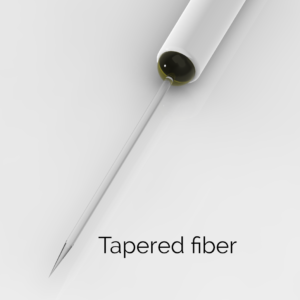
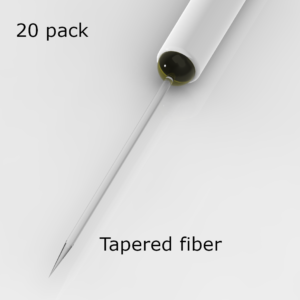
Lambda fibers are optical fibers that have been tapered down on one end from their full width to less than 1um diameter over a length of few millimiters.

The peculiar optical property of Lambda fibers is that the optical modes guided by the fiber along its non-tapered portion are out-coupled at different positions along the taper.

This means that by exciting all the optical modes of the fiber (i.e. by injecting the light with an optical source having the same or higher Numerical Aperture than the fiber), light will be emitted diffusedly from the taper [1]:

FIG2-1

Even more interestingly, by exciting only a subset of modes by unconventional light delivery strategies -one method is to inject with a changing angle a collimated light beam into the proximal end of the fiber- it is possible to restrict light emission to only a sub-portion of the taper [1]:

This relation between the modal content of the guided light and the active portion or sub-portion of the taper is maintained when using a Lambda fiber for light collection [2].

To obtain higher repeatability among different fibers and to achieve a uniform emission length along the scanning range, the use of Lambda-plus fibers is recommended: Lambda-plus fibers are tapered fibers selected with strict tolerance on the taper profile.

Lambda fibers enable a new way to conduct Optogenetics and Fiber Photometry experiments. Since light delivery / collection takes place from the tapered surface, Lambda fibers are typically inserted into the region to be controlled.

The portion of the taper that effectively emits/collects light is defined by the active length.

fiber

Since the optically active surface is larger for a Lambda fiber than for a standard fiber – the surface of a cone with an height equal to the active length vs the fiber core area – a larger total input optical power is needed to obtain the same illumination power density.

The average illumination power density emitted by the active surface of the taper can be calculated as the total light power emitted by the tapered fiber divided by the active area of the tapered fiber. The total light power can be measured by placing the tapered fiber in front and very close to a light power sensor, as is commonly done with flat fibers. The active area in squared millimeters can be calculated as the product of the active length of the taper (in millimeters) and a fiber-type dependent coefficient a:

Fiber type.22/105.39/200.66/200
Coefficient a [mm]0.0860.1890.243

NEW! Download LightSpread software to estimate how the light emitted by a Lambda fiber is distributed in the brain tissue [3, 4].

REFERENCES

[1]  F. Pisanello, et al., “Dynamic illumination of spatially restricted or large brain volumes via a single tapered optical fiber”, Nature Neuroscience (2017).

[2] F. Pisano, et al., “Depth-resolved fiber photometry with a single tapered optical fiber implant”, Nature Methods (2019).

[3] L. Wang, et al., “MCML—Monte Carlo modeling of light transport in multi-layered tissues“, Computer Methods and Programs in biomedicine (1995).

[4] J. M. Stujenske, et al., “Modeling the spatiotemporal dynamics of light and heat propagation for in vivo optogenetics“, Cell Reports (2015).