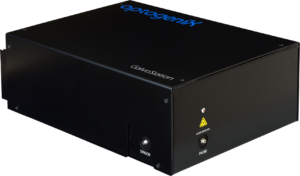
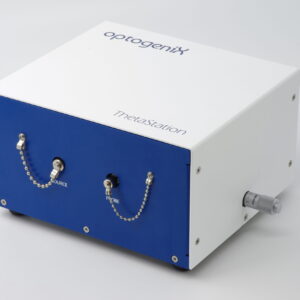
GalvoStation is a single channel opto-electronic laser device specifically designed to perform spatial selectiveOptogenetics and Fiber Photometry with OptogeniX Lambda Fibers.
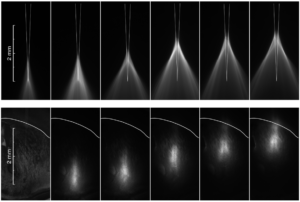
GalvoStation allows to confine the light emitted by a Lambda Fiber at sub-sites of its active length. The active sub-site can be scanned arbitrarily along the fiber axis within the active length.
This feature can be exploted to illuminate different brain regions with depth resolution in order to i) record the photo-induced elctrophysiology signal at different depths with a multielectrode array [1], or ii) collect the fluorescence signal from different brain regions in a depth-resolved fiber photometry experiment [2].
Axial resolution of site selective light delivery/collection with Lambda fibers is represented by the sub-site length. To obtain higher repeatability among different fibers and to achieve a uniform emission length along the scanning range, the use of Lambda-plus Fibers is recommended (see details below).
GalvoStation can be equipped with one or two laser sources and optionally include an optical path for combined light delivery and collection with a single probe. Examples of options sets with related applications are listed in the following table.
Laser wavelengths [nm]
Collection band [nm]
Application example
405 + 473
500 – 550
GCaMP based spatial selective Fiber Photometry with isosbestic control
473
N/A
ChR2 based spatial selective optogenetics
405 + 561
600 – 650
RCaMP based spatial selective Fiber Photometry with isosbestic control
Lambda-plus Fibers
To obtain higher repeatability among different fibers and to achieve a uniform emission length along the scanning range, Lambda-plus Fibers are strongly recommended for use with the GalvoStation. Lambda-plus Fibers are Lambda Fibers selected with strict tolerance on both taper length and taper profilefor a constant sub-site length among fibers of different batches. Visit the Lambda-plus Fibers shop page for an updated list of specs currently available and related axial resolution.
Customization
GalvoStation is designed with flexibility in mind: we welcome requests for customized configurations tailored to specific research needs beyond our standard options.
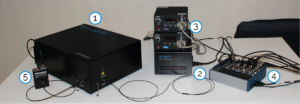
The complete GalvoStation system consists of the GalvoStation (1), its power supply (2), one or two laser drivers (3), a DAQ board (optional, 4), and a photodetector (optional, 5). A set of patch fibers and all the cables needed are supplied with the system, accordingly to the chosen configuration.
Detailed list of accessories:
Two 2m long D-Sub15 cables.
One probe patch cord (SMA905 to ferrule).
One sensor patch cord (SMA905 to FC/PC).
Three 0,5m long BNC cables.
Four 2,0m long BNC cables.
Three BNC-Tee adapters.
One 2m long 3 pin DIN cable.
Three C13 AC cable.
One DAQ power supply.
A starter kit is also included. It is composed by: one 5pack of Lambda-plus fibers (fiber type and stub specifications as defined by the customer, including one calibration slide); one probe patch cord (same fiber type of the Lambda-plus fibers); one sensor patch cord.
In case a rotary joint is to be used, an additional patch cord will be provided with connectors specified during the order.
Probe patch cords provided with the equipment are recommended for optimal use with Lambda-plus fibers and TaperScan software. Contact us to re-order Lambda-plus fibers and GalvoStation probe patch cords.
The sensors patch cord provided with the GalvoStation is based on a high Numerical Aperture fiber for suitable use with the photodetector optionally included. In case of use with your own photodetector, please consult manufacturer’s guidelines for selection and purchasing of the photodetector patch cord.
TaperScan software
TaperScan software is available for full control of the GalvoStation. It allows to select the active sub-site of the Lambda fiber, the operating laser source and its optical power level. Two modes of operation are implemented: manual mode for direct manual control of the spatial selective light emission from a Lambda fiber, and protocol mode, with which it is possible to program both single source (e.g. for Optogenetic stimulation) and dual source (e.g. for Fiber Photometry with isosbestic control) stimulation routines. TaperScan supports the input from two digital TTL ports to record the occurring of event.