

Application | Optogenetics
Full taper light delivery
This mode of operation is typically employed with Lambda fibers to target large volumes of tissue more homogeneously and efficiently than flat-cut optical fibers [1]. Lambda fibers are typically inserted into the region to be controlled. The tapered profile with sub-micron tip diameter minimizes tissue displacement and insertion damage [1].
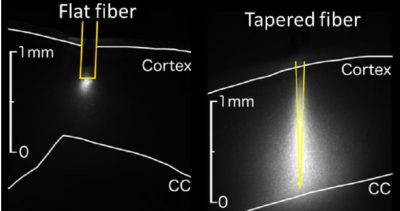
How to do
Full taper light emission can be achieved by direct connection of the Lambda fiber to a Laser or LED light source via a patch cable.
For correct operation, the Numerical Aperture (NA) of the light source should be at least equal to that of the tapered fiber (NA_source ≥ NA_fiber). Using a patch cable with the same NA and fiber core size of the Lambda fiber is recommended.
The average illumination power density emitted by the active surface of the taper can be calculated as the total light power emitted by the tapered fiber divided by the active area of the tapered fiber. The total light power can be measured by placing the tapered fiber in front and very close to a light power sensor, as is commonly done with flat fibers. The active area in squared millimeters can be calculated as the product of the active length of the taper (in millimeters) and a fiber-type dependent coefficient a:
| Fiber type | .22/105 | .39/200 | .66/200 |
| Coefficient a [mm] | 0.086 | 0.189 | 0.243 |
Application | Optogenetics
Spatial selective light delivery
Light emission can be restricted to sub-portions of the taper by the use of unconventional light delivery methods [1]. Emission profiles depend on the Lambda fiber geometry as well as the actual light source employed.
N.B.: This feature can also be employed to correct for implantation errors or uncertainty.
REFERENCES
[1] F. Pisanello, et al., “Dynamic illumination of spatially restricted or large brain volumes via a single tapered optical fiber“, Nature Neuroscience (2017)